

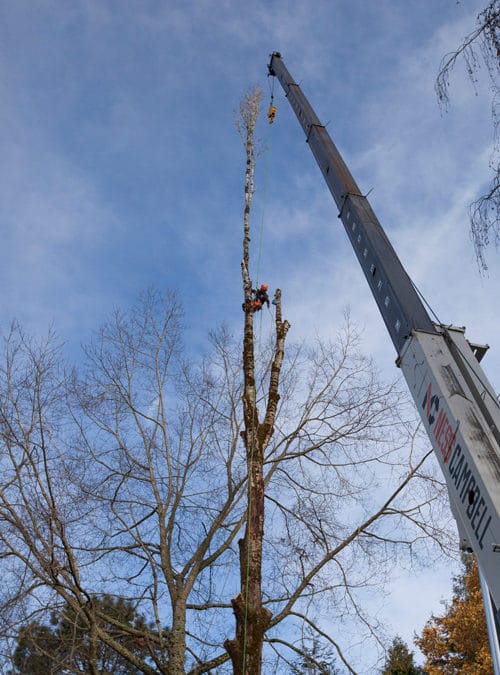
Nobody can quote your tree accurately over the phone, and any company that does is either guessing high to protect themselves or guessing low to win the job and revise later. What we can do is explain exactly what a real estimator is measuring, so the number you receive makes sense.
Five factors drive nearly all of the price difference between two removals.
1. Size, but volume rather than height
Height is what homeowners describe and volume is what actually costs money. A 60-foot Douglas fir with a 20-inch trunk and a 100-foot Douglas fir with a 40-inch trunk are not a 40 percent difference — the larger tree may hold four or five times the wood. That wood has to be cut, rigged, lowered, moved, and hauled.
Trunk diameter tells an estimator more than height does.
2. Access, which is often the biggest variable
This is the factor homeowners consistently underestimate. A tree in an open front yard with a driveway alongside it can often be reached with equipment, dropped in large pieces, and cleaned up quickly.
The same tree in a fenced back yard, behind a shed, with a neighbor’s greenhouse on one side, becomes a climbing job. Every piece gets rigged, lowered by rope, carried out by hand, and walked to the truck. That is a completely different labor picture for identical wood.
If equipment cannot reach the tree, expect the price to reflect it.
3. What the tree can hit
In the industry these are called targets: the house, the garage, power lines, a fence, a septic field, a pool, the neighbor’s roof. Targets do not just add risk, they change technique. A tree that can be felled in one piece into open lawn is straightforward work. A tree leaning over a roof has to be dismantled from the top down in controlled sections.
Anything near utility lines adds coordination and, depending on the line, may require the utility to be involved. High-risk removals are priced on complexity, not just size.
4. Species and condition
Species matters more than people expect. Western red cedar is comparatively light. Big leaf maple is heavy, unpredictable, and prone to including hidden decay in unions. Douglas fir is tall and heavy but usually predictable.
Condition matters more still. A healthy tree behaves the way the crew expects when they cut it. A dead or decayed tree does not — you cannot rely on the wood to hold a rigging point or hinge properly. Dead trees are frequently more expensive than live ones of identical size for exactly this reason, which surprises almost everybody.
5. What happens to the debris and the stump
Ask what the quote includes, because this is where quotes stop being comparable:
- Are logs hauled away, or left cut and stacked on site?
- Are chips hauled, or blown back into your beds?
- Is the stump ground, or cut flush and left?
- If ground, how deep, and are the grindings removed or left to backfill the hole?
Stump grinding is usually a separate line item. Leaving logs on site can reduce cost if you want the firewood.
Why the cheapest quote is often the most expensive
When one bid comes in dramatically under the others, there is almost always a reason. The common ones:
- No real insurance. If an uninsured crew damages your house or injures someone on your property, that can become your problem. Ask for a certificate of insurance sent directly from their carrier.
- Cleanup excluded. The price drops considerably if you are the one dealing with the wood.
- No credentialed arborist involved. Cutting a tree down is not the same skill as knowing whether it needs to come down.
Ask every bidder the same three questions: are you licensed, bonded, and insured in Washington; is there an ISA Certified Arborist on staff; and what exactly does this price include.
How to get an accurate number
Have someone come look at it. A real estimate takes a few minutes on site, and any reputable company in Clark County will provide one without charge for standard residential work. Photos help for a rough conversation, but access and targets are hard to judge from a picture.
Cascade Tree Works serves Vancouver, Battle Ground, Camas, Brush Prairie, La Center, Washougal, Ridgefield, and Hockinson. Our ISA Certified Arborists can look at your tree and tell you plainly what it needs. Request a residential estimate.

