
Of all the structural defects we point out to homeowners, this is the one that produces the most surprise. The tree looks healthy. It has a full canopy. And the place where it divides into two trunks is quietly the reason it may come apart in a storm.
What codominant means
A well-structured tree has one dominant central leader, with lateral branches noticeably smaller than the trunk they attach to. That size difference is what makes the attachment strong.
A codominant tree has two or more stems of roughly equal size competing for the lead position, neither clearly subordinate. Instead of a branch joining a trunk, you have two trunks meeting at a junction — and that junction has to carry the load of everything above it.
The part that determines whether it matters
Not every double-trunked tree is a problem. What separates a sound union from a dangerous one is what is happening inside where the two stems meet.
A strong union shows a raised ridge of bark in the crotch, called a branch bark ridge. That ridge is the visible sign that the two stems have grown wood together, layer by layer, interlocking. It is genuinely connected.
A weak union has included bark. Instead of growing together, the two stems have grown against each other, trapping a layer of bark between them. Bark has no structural strength. What looks like a solid junction is two pieces of wood pressed together with a seam of dead bark in between, acting like a wedge that gets driven deeper every year as both stems expand.
You can often tell them apart from the ground. Look into the crotch:
- Raised ridge, U-shaped, wide angle — generally sound
- Seam or crease pressed inward, tight V, no ridge — included bark, structurally weak
Why they fail when they fail
Included-bark unions fail in exactly the conditions you would expect: wind loading, heavy wet snow, ice, or the extra weight of a fully leafed canopy in a summer storm.
The failure is usually sudden and it is usually dramatic. Because both stems are large, losing one means losing half the tree, and the tear frequently runs down into the main trunk rather than stopping at the union — which often takes the remaining half from salvageable to unsalvageable.
Warning signs that a union is already moving:
- A visible crack or seam extending down the trunk from the crotch
- Any gap you can see into at the junction
- Decay, moisture staining, or fungus in the crotch, where trapped debris holds water
- One stem appearing to have shifted or dropped relative to the other
- Ribbed or bulging wood alongside the union, indicating the tree is trying to reinforce a stressed area
A visible crack at a codominant union on a large tree near a structure is not a monitoring situation. Get it assessed.
Species where this shows up most around here
In Clark County we see it constantly in big leaf maple, which grows fast, gets very large, and frequently forms multiple codominant stems with poor unions. It is common in ornamental cherries and plums, in birch, and in fast-growing shade trees planted in subdivisions.
Conifers are less prone but not immune — a Douglas fir that lost its leader to damage or topping often responds by growing two competing replacement leaders, producing exactly this defect at height.
What can be done
On young trees, this is completely fixable and cheap. Structural pruning while the tree is small reduces or removes one of the competing stems, establishing a single dominant leader. Ten minutes of correct pruning on a young tree prevents a several-thousand-dollar problem twenty years later. This is the highest-return tree work that exists and almost nobody does it.
On mature trees, the options are more limited but real:
- Reduce end weight. Pruning back the ends of the limbs on one or both stems lowers the leverage acting on the union. Less weight at distance means less force at the junction.
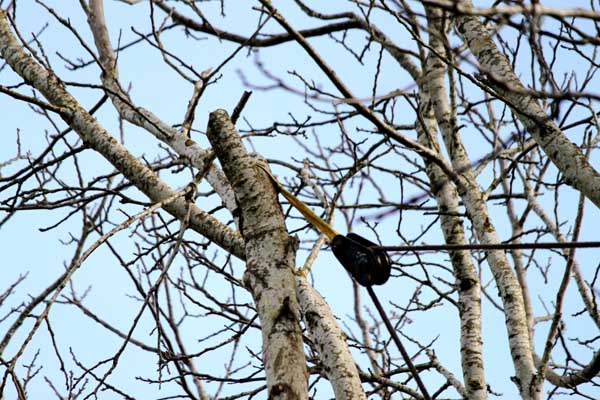
- Cable or brace. Cabling installs hardware between the two stems to limit how far they can move independently. Done properly it can extend the life of a tree worth keeping considerably. It requires correct placement and periodic inspection, and it does not make the tree permanently safe — it manages a known defect.
- Remove one stem. Sometimes viable, sometimes leaves a badly unbalanced tree and a very large wound.
- Remove the tree, where the defect is severe and the target is important.
Which of these applies depends on the size of the tree, how far the defect has progressed, and what sits underneath it. That is a judgment call for someone who can get eyes on the union.
Cascade Tree Works serves Vancouver, Battle Ground, Camas, Brush Prairie, La Center, Washougal, Ridgefield, and Hockinson. Our ISA Certified Arborists can look at your tree and tell you plainly what it needs. Request a residential estimate.